Site Wire Frame
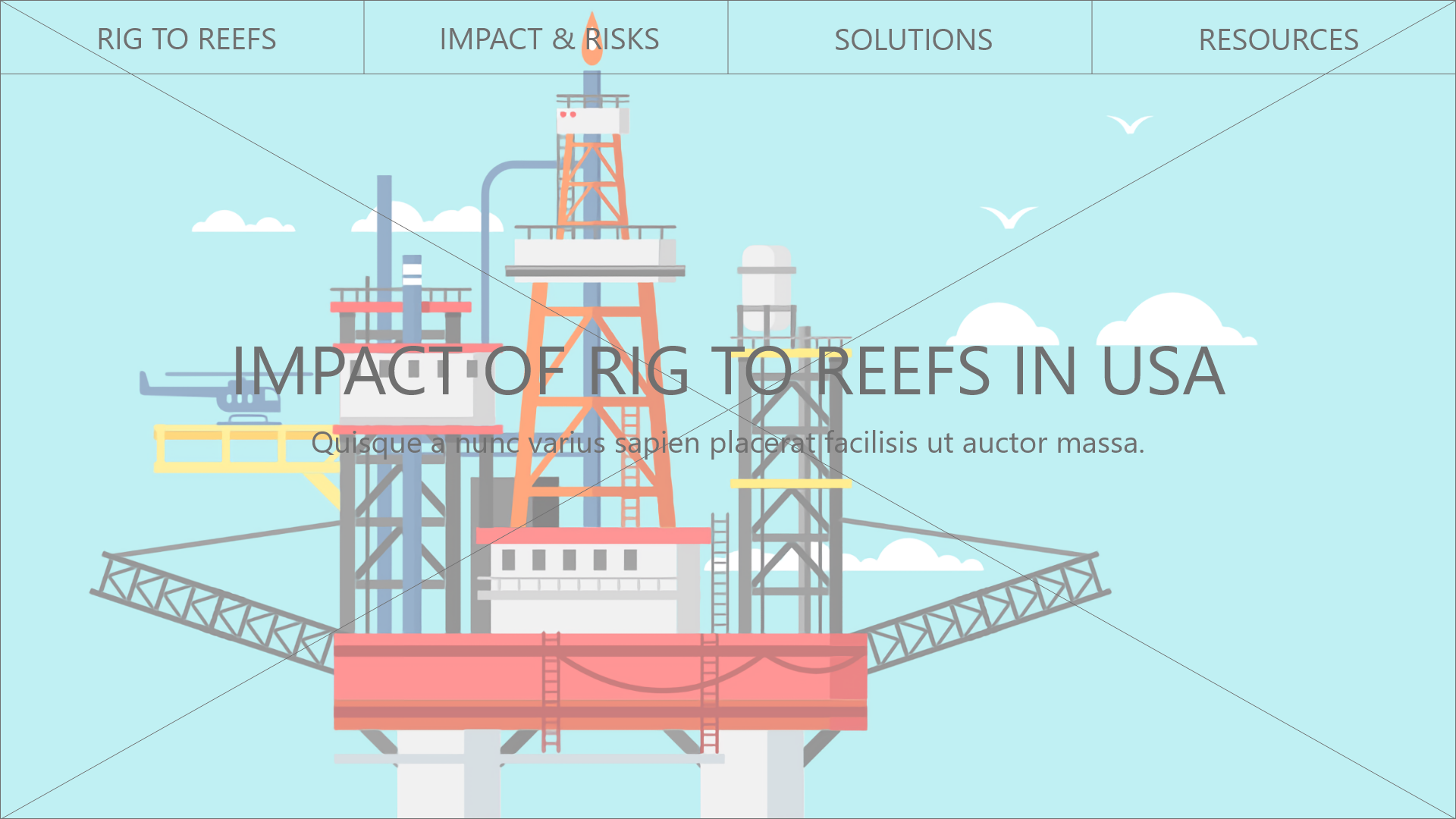
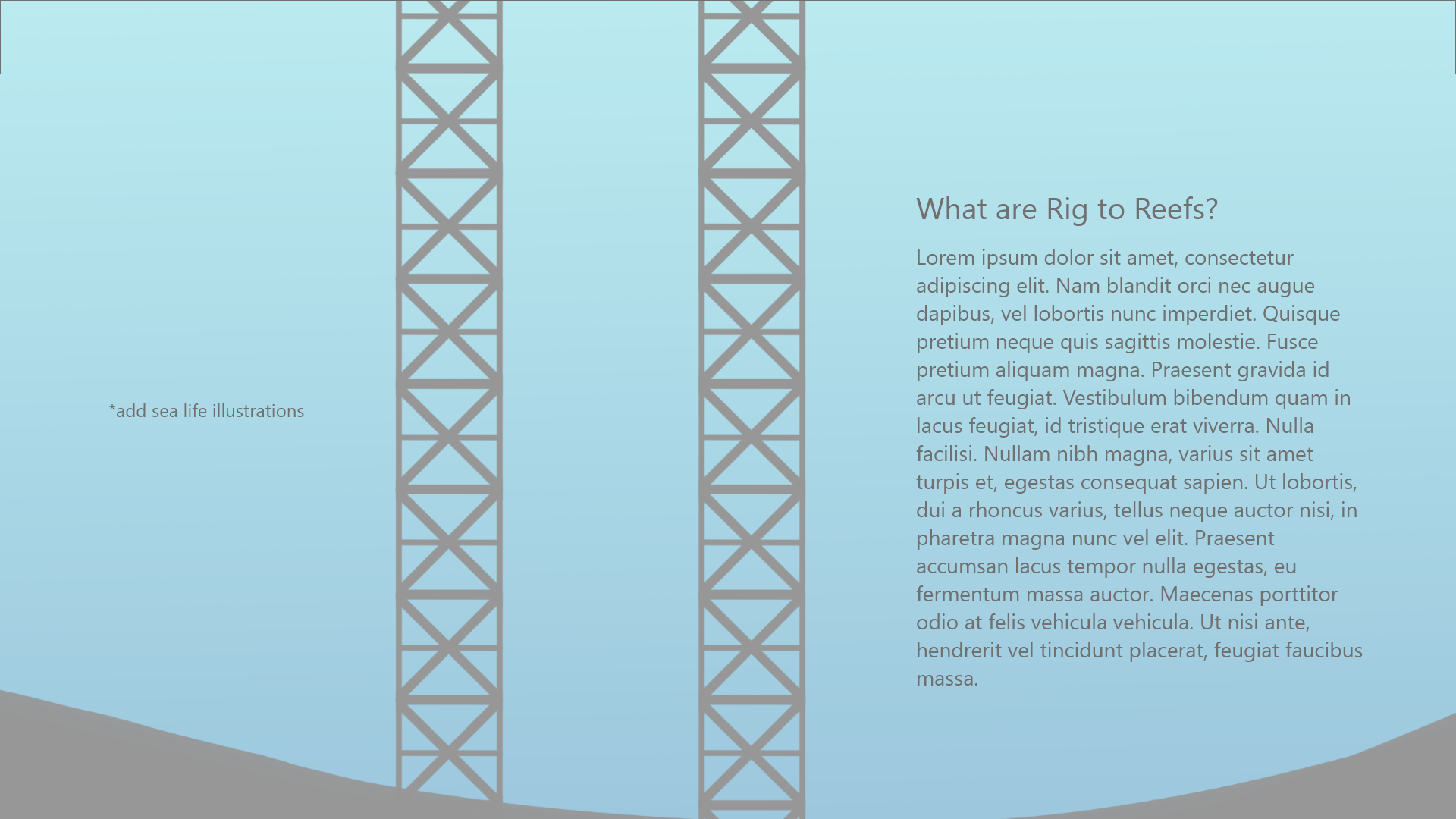
First iteration of Impact to Rigs to Reef’s about page
Inspired by What Is Offshore Decommissioning [Infographic] and Rigs to Reef: Transecting Borneo (Trailer) we’ve decided to make our site in a parallax scrolling website format. In the video trailer, it starts off with a zoomed out shot of the oil rig above water. As the video continues viewers are guided down the structure of the oil rig, thus giving a sense of immersion and exploration. Similarly, a section of the info graphic takes you down the structure of the oil rig as you scroll down, which also helps clearly illustrate the information they’re trying to convey with it. For our site we want it to have a similar effect. Specifically, like our inspirations, as the user scrolls down our site it takes them down the structure of an oil rig. This helps the user to instantly visualize what an offshore oil rig is and how marine life co-exists with oil rigs. Moreover, readers are able to grasp what the site is about upon first glance.
Site Contents
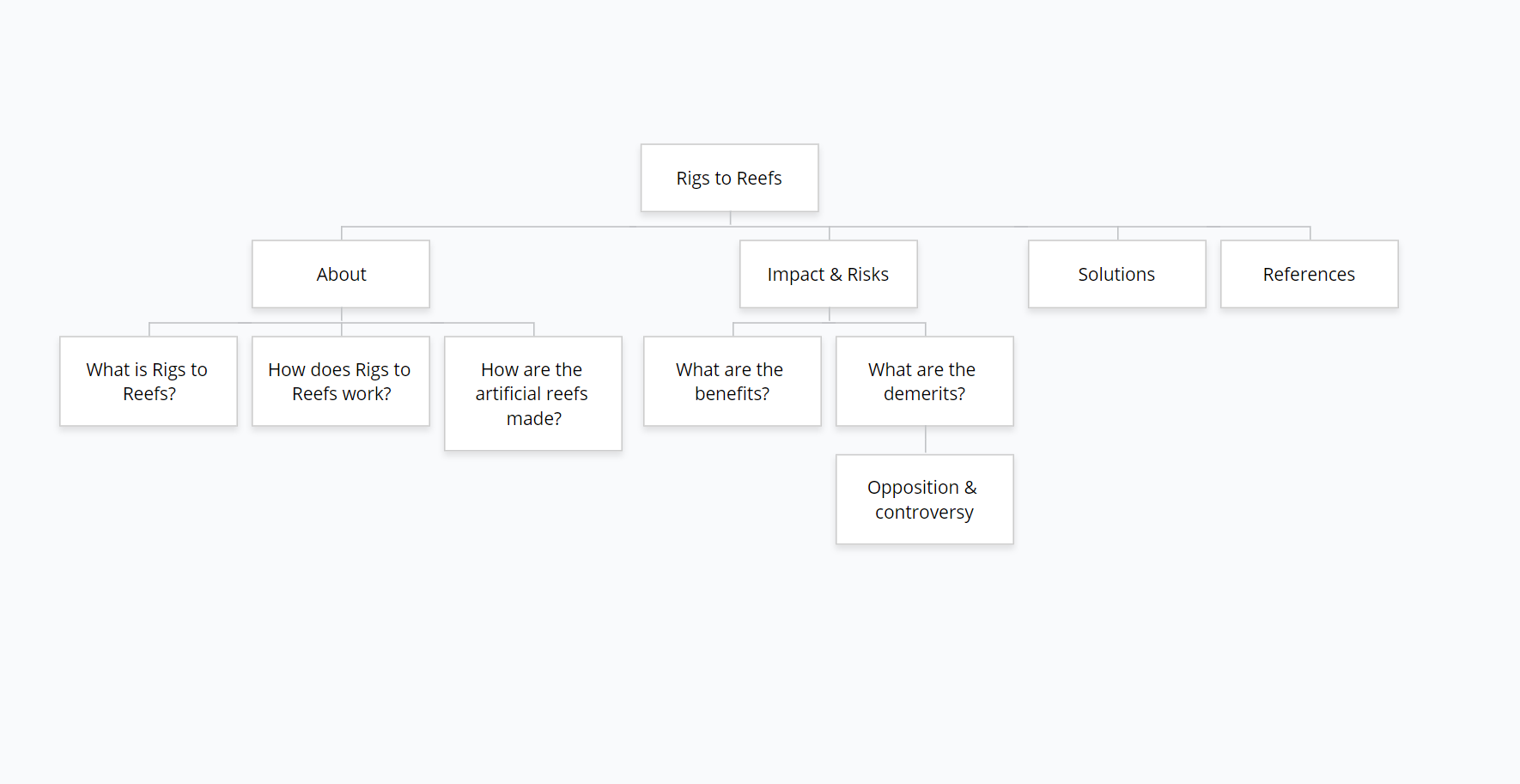
What is Rigs to Reefs?
Once an offshore oil rig stops producing oil at economic rates, the site is usually simply abandoned due to the cost and work it takes to decommission a platform. However, in USA, the Mineral Management Service requires operators to remove the rig within a year of stopped production. The concept of Rigs to Reefs was first explored in the late 1970s when they realized offshore platforms are artificial habitats. They notice that around these structure there is an increase in algae and invertebrate along with a significant increase in the numbers and species of fish. The ocean is a big empty place and animals tend to concentrate around objects. Invertebrates need things to latch onto and fish want to hide in nooks and crannies, or just be around anything with a little structure to it.
When an offshore rig is removed from the environment, it destroys the habitat that has been created and disrupts the organisms residing at the site. Moreover, explosive removals of rigs are estimated to kill over 800 fish. Fishermen, divers, and coastal states have been concerned with the removal of these structures heavily-populated with marine life. Therefore, as an alternative to total removal, Bureau of Safety and Environmental Enforcement — an agency under the government of United States — BSEE, began to work with interested parties and coastal states to address these concerns, thus creating Rigs to Reefs where decommissioned oil rigs are converted into artificial reefs.
How are the artificial reefs made?
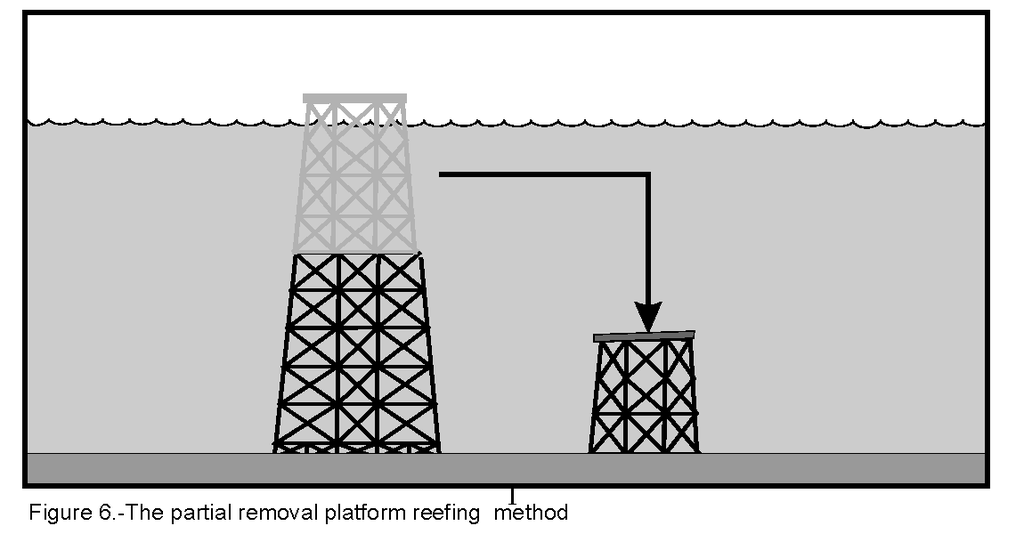
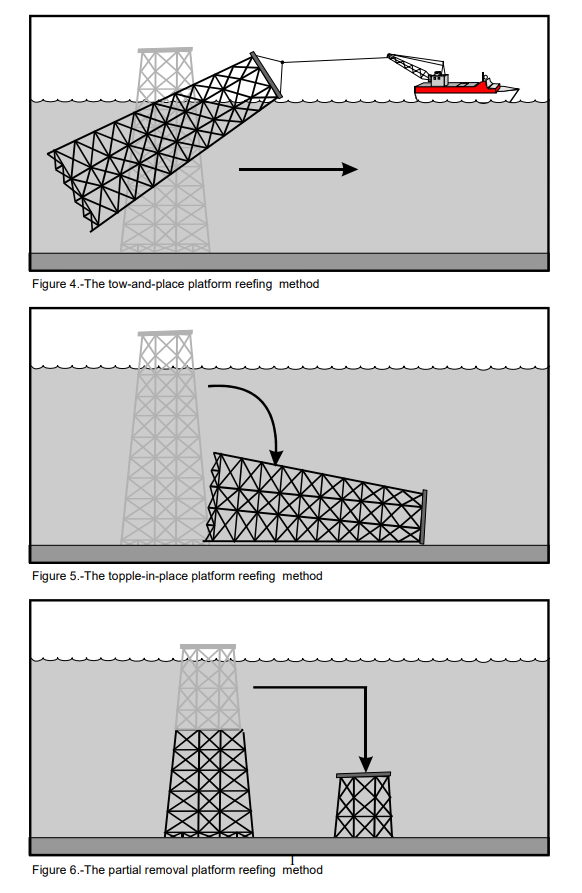
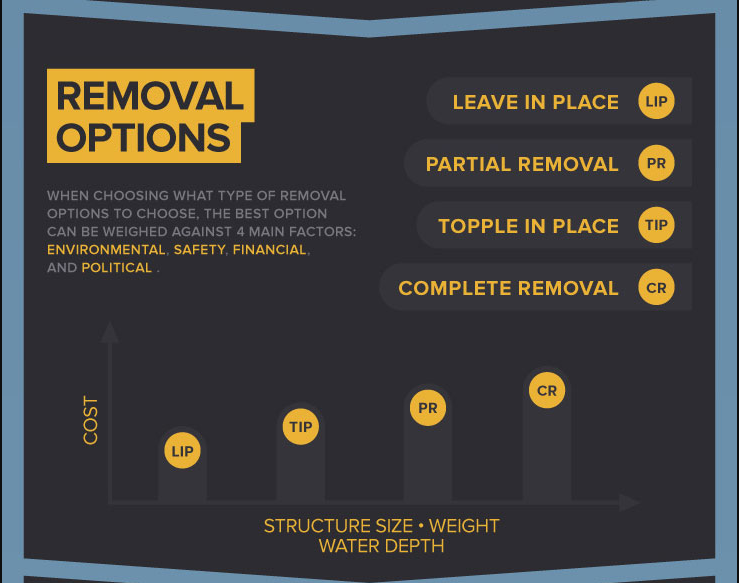
Three general methods are used for removing and “reefing” a retired structure: 1) tow-and-place, 2) topple-in-place, and 3) partial removal.
- Tow-and-place involves severing the structure from the sea floor either using explosives or mechanical cutting techniques and then towing it to the selected reef for deployment.
- Topple-in-place also detaches the structure from the seabed. The detached structure is then toppled onto its side.
- Partial removal generally does not use explosives. The top portion of the structure is severed at a permitted navigational depth, typically 85 feet deep, and placed on the sea floor next to the base of the remaining structure.


California Information:
In 1984 the National fishing enhancement act was created to offset overfishing and habitat degradation established by artificial reefs. The act requires that all artificial reefs be designed, constructed and sited according to existing laws and regulations.
Nation Artificial Reef Plan Criteria Guidelines
Biological Considerations
- Bottom Substrate – Avoid setting up reefs on pre existing ecosystems. The act considers current lifeforms at the reefs. Creating an artificial reef at the expense of an existing ecosystem would be counterproductive.
- Hydrography – wave height and hydrological elements for example, water depth and current strength has to be considered. Artificial reefs in clear or shallow water that experience good light penetration have demonstrated higher levels of productivity (NARP 2007).
- Water quality – Factors such as turbidity, oxygen content and oxygen demand, water temperature, and nutrient loads and pollution all affect the potential success of artificial reefs.
Construction Considerations
Approve or deny materials for reef construction rests with the Artificial reef plan and existing federal regulations All approved materials should be inspected to ensure they meet the following requirements; they must be environmentally safe, structurally and physically stable, practical, and capable of being deployed in a manner that is both safe and cost-effective. (NARP 2007).
- Function – Materials used in the construction of artificial reefs should be known to attract and support the targeted organisms; both sessile invertebrates that create the ecosystem, and fish species that are commercially and recreationally viable.
- Compatibility – Materials used must be compatible with the environment and marine life.
- Stability – Materials must be stable and resistant to movement
- Durability – Materials must be resistant to deterioration and break up over time.

Decision tree of decommissioning options

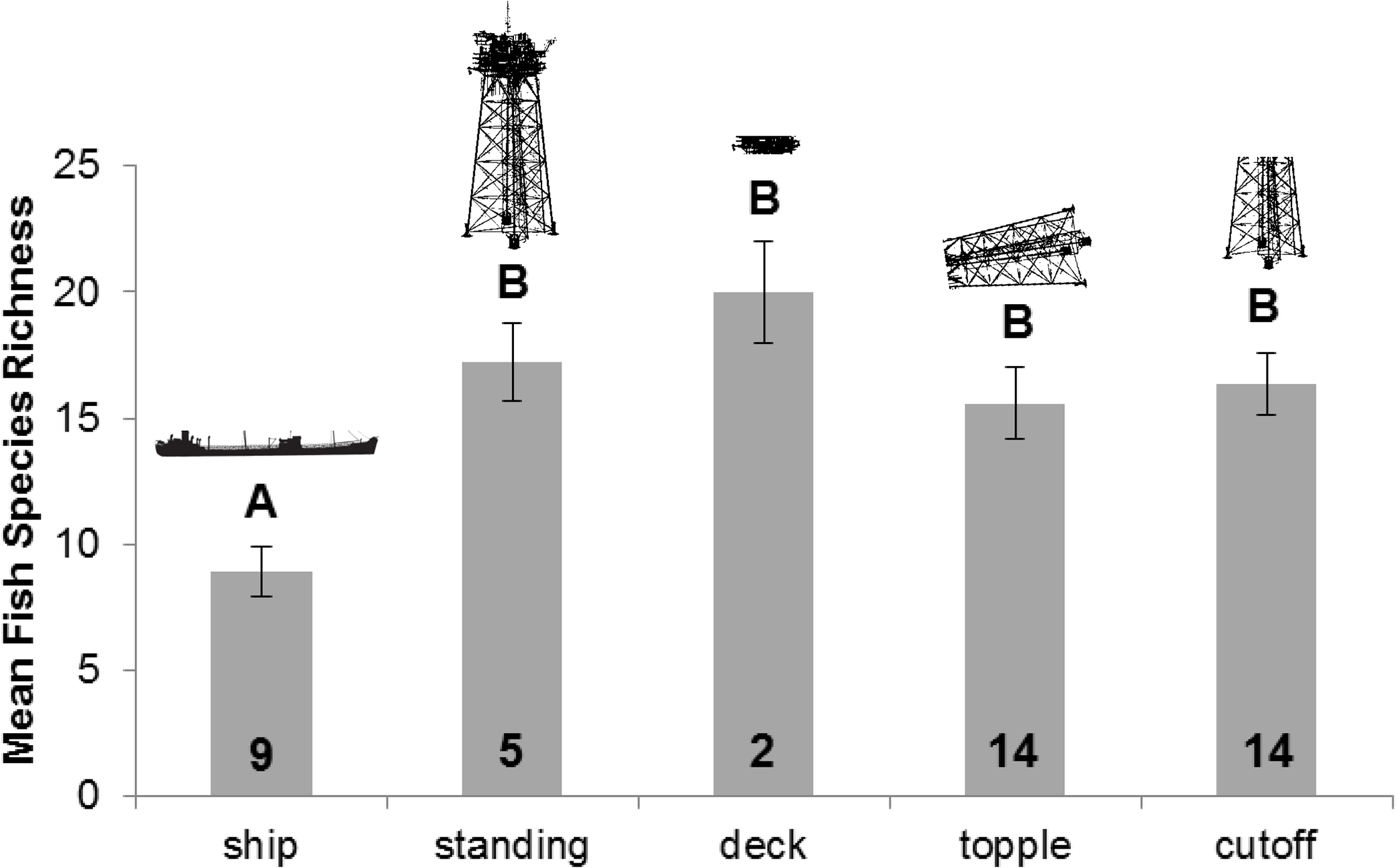
Vertical bar chart of mean species richness by structure type

Scatter plots of species richness by structure height (A) and bottom depth (B).
Challenges for the Project
Looking at the projects that people did in previous year, many of them had a ‘solutions’ or something like a call for action section. Referencing that, we put a ‘solution’ category in the wire frame, however in our topic there is nothing concrete to solve. We’ve been spending time finding something similar in place of that and that has been a challenge so far.
Possible Solutions
As our project topic is more informative more than anything, there is nothing specific to ‘solve’, thus leading to a lack of ‘solution’ section. Rigs to Reefs are not necessarily bad, but there are oppositions and controversy around it, but that is not something we can ‘solve’. As to take this topic further, rather than just being another information page, we could offer our own insight on what each side can do to collaborate, but then the site might not be seen as neutral anymore. Nonetheless, perhaps we could take a step back for the ‘solution’ section and address it from a boarder scope. Specifically, we could provide insight and solutions to lessen the damage oil rigs do to marine life and talk about ways how citizens can help preserving marine life.
References
https://www.bsee.gov/what-we-do/environmental-focuses/rigs-to-reefs
http://www.rig2reefexploration.org/read-me
https://psmag.com/environment/rejiggering-the-rigs
https://chooseyourcurrent.org/2018/04/how-offshore-drilling-works/
https://www.newsdeeply.com/oceans/community/2018/05/18/rigs-to-reefs-giving-oil-platforms-a-second-life-for-conservation
https://tpwd.texas.gov/landwater/water/habitats/artificial_reef/rigs-to-reefs.phtml
https://aoghs.org/offshore-history/rigs-to-reefs/
https://99percentinvisible.org/episode/crude-habitat/
https://www.offshore-technology.com/features/featuredisused-oil-rigs-living-reefs-pictures/
https://petrowiki.org/Offshore_decommissioning
https://mission-blue.org/2017/07/viewpoints-rigs-to-reefs/
https://www.boem.gov/BOEM-Newsroom/Library/Publications/2000/2000-073.aspx

 Impact of Rigs to Reefs in USA